 Formada3D
 Carbon-fibre filaments compared: which CF grade for a functional part?
“Carbon fibre” on a spool can mean a stiffer PLA for a jig, a nylon that survives next to a motor, or a lot of money spent on a bracket that PETG would have handled. Here is what the fibre actually changes, how five grades compare on their data sheets, and what each one costs to print in Australia today.
The short answer
- Carbon fibre mainly adds stiffness, not strength. PETG-CF is about 42 % stiffer than PETG but no stronger along the layers.
- Stiff indoor jigs and fixtures: PLA-CF, from A$13.11 for our reference block. Keep it below about 55 °C.
- Stiff parts that go outside or get warm: PETG-CF, from A$13.49.
- Structural parts near heat: PA6-CF (stiffest when dry, from A$30.03) or PET-CF (low moisture uptake, from A$35.69).
- Humid or wet environments with heat: PAHT-CF, from A$35.94: it keeps far more of its strength when damp than PA6-CF.
What does carbon fibre actually do in a filament?
Carbon-fibre filament is an ordinary base plastic (PLA, PETG, PET or nylon) filled with very short chopped carbon fibres. As the plastic is pushed through the nozzle, most fibres line up along the direction of travel. That gives three changes you can feel in a part: it is stiffer (it flexes less under load), it is steadier in size (the fibres restrain shrinkage, so large flat parts warp less), and the surface is a matte, slightly textured finish that hides layer lines.
What it does not do is turn a plastic into carbon-fibre composite like a bike frame. Chopped fibres are short and not continuous, so the base plastic still decides heat resistance, chemical resistance, moisture behaviour and most of the strength. A PLA with carbon fibre is still PLA in a hot car.
The fibres are also abrasive. They add nozzle wear, and the nylons and PET-CF must be dried before printing (their data sheets ask for 80 °C for 8 to 12 hours in a forced-air oven). That is a large part of why these grades cost more per part than the filament price alone suggests.
How do the grades compare on their data sheets?
All six materials below come from one maker, Bambu Lab, tested with the same ISO methods, which makes them unusually comparable. Their test bars are printed at 100 % infill and annealed and dried before testing, so treat the figures as the ceiling for each material, not a promise for your part. PETG without fibre is included as a reference.
| Material | Stiffness X-Y | Tensile X-Y | Tensile Z | HDT | Water | Density |
|---|---|---|---|---|---|---|
| PETG (no fibre) | 2,050 | 34 | 23 | 69 °C | 0.40 % | 1.28 |
| PLA-CF | 3,950 | 38 | 26 | 55 °C | 0.42 % | 1.22 |
| PETG-CF | 2,910 | 35 | 29 | 74 °C | 0.30 % | 1.25 |
| PET-CF | 5,320 | 74 | 35 | 205 °C | 0.37 % | 1.29 |
| PA6-CF | 5,460 | 102 | 48 | 186 °C | 2.35 % | 1.09 |
| PAHT-CF | 4,230 | 92 | 47 | 194 °C | 0.88 % | 1.06 |
Sources: Bambu Lab technical data sheets (PETG HF TDS V1.0 · PLA-CF TDS V2.0 · PETG-CF TDS V3.0 · PET-CF TDS V3.0 · PA6-CF TDS V3.0 · PAHT-CF TDS V3.0). Stiffness = bending modulus in MPa (ISO 178); tensile strength in MPa (ISO 527); HDT = heat deflection temperature at 0.45 MPa (ISO 75); water = saturated water absorption at 25 °C and 55 % RH; density in g/cm³. X-Y = along the layers, Z = across them.
Three things stand out. First, PETG-CF's tensile strength is the same as plain PETG's (35 vs 34 MPa) while its stiffness is about 42 % higher. Second, PLA-CF is stiffer than PETG-CF, but its heat deflection temperature is 55 °C, the lowest here. Third, the engineering grades are in a different class: PET-CF, PA6-CF and PAHT-CF are two to almost three times as stiff as PETG and two to three times as strong along the layers, with datasheet heat deflection well above 150 °C.
A note on heat. The heat deflection figures are for annealed, solid test bars. A real part with infill, printed and not annealed, will soften sooner. For quoting we plan with lower working figures from our materials guide: about 120 °C for PET-CF, 150 °C for PA6-CF and PA6-GF, and the datasheet 194 °C for PAHT-CF only when it is dried and annealed.
Grade by grade: what each one is for
PLA-CF: stiff, easy, indoor
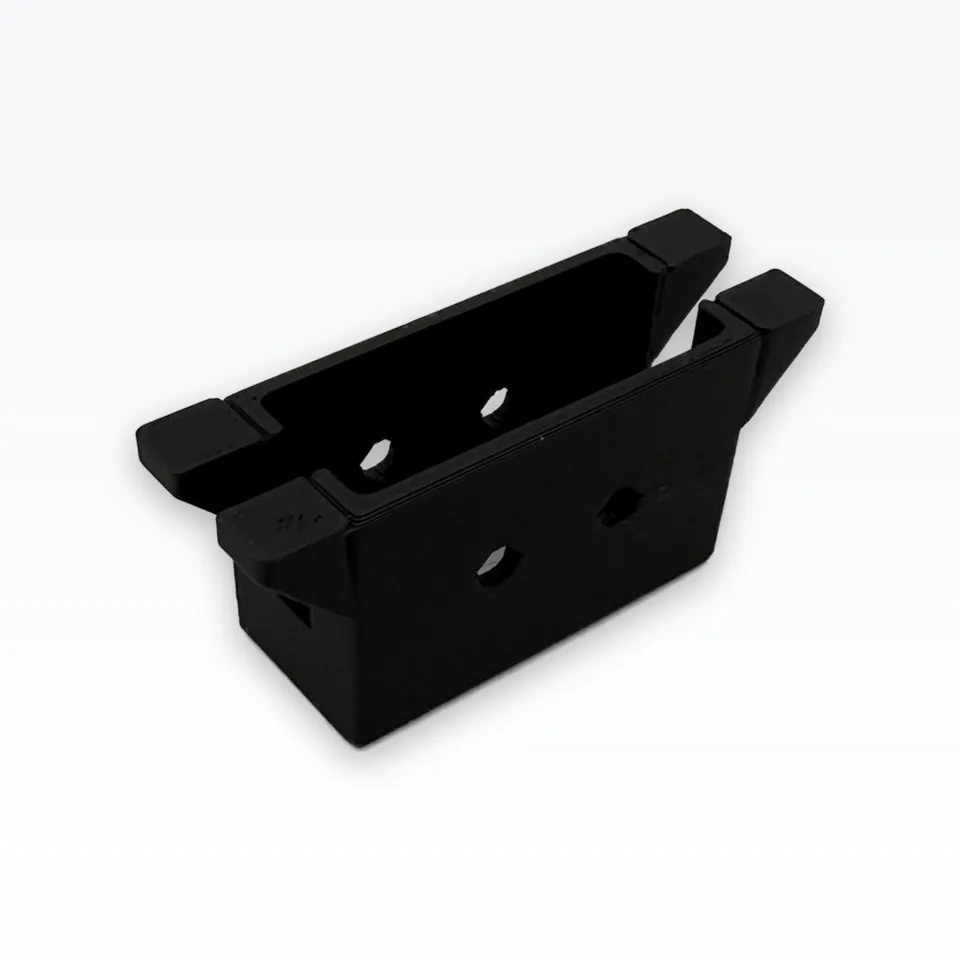
PLA-CF prints cleanly, holds its size well and looks good, with almost invisible layer lines. It is our pick for assembly jigs, drilling guides, inspection fixtures and camera mounts that live indoors. Its limits are heat (about 55 °C) and impact: stiff means less give, so a dropped part can crack where PETG would bend. See PLA-CF in our materials guide.
PETG-CF: the default CF for brackets and mounts
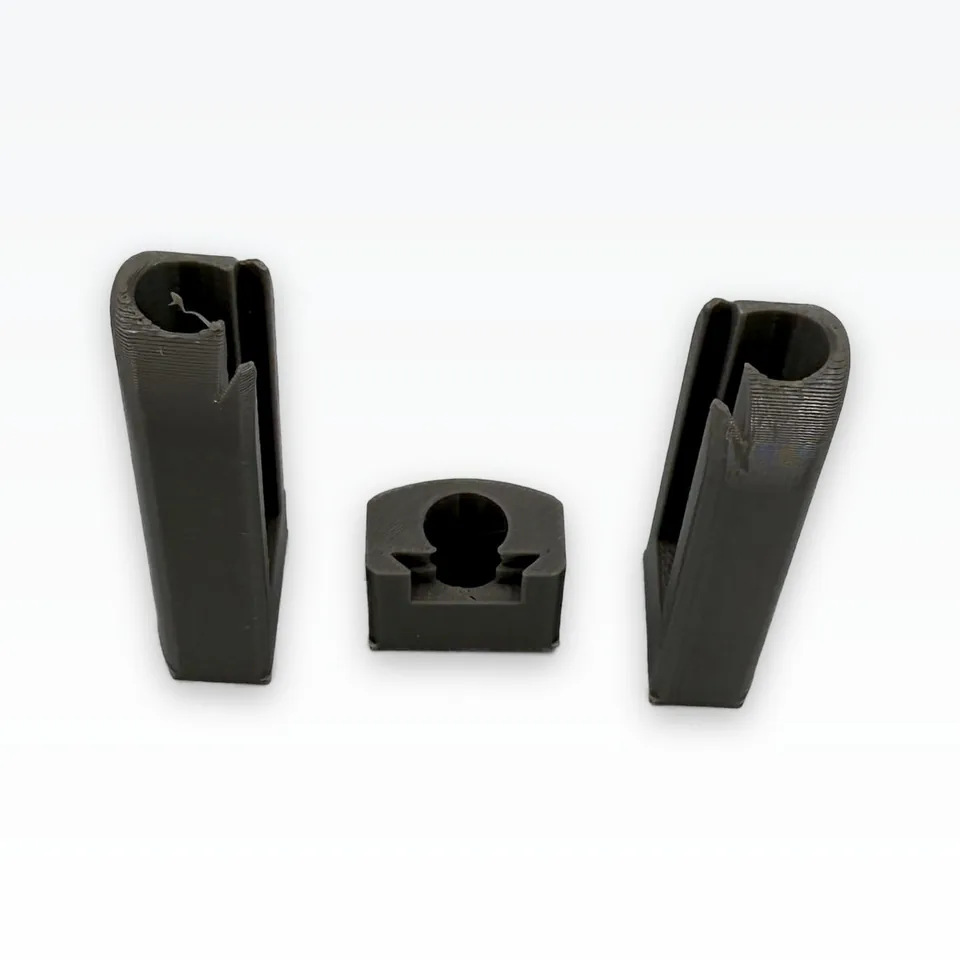
PETG-CF keeps everything that makes PETG a good functional plastic: toughness, water resistance and outdoor use. It adds stiffness and a dimensionally steady, matte part. It suits robot and machine mounts, sensor brackets and outdoor brackets where flex is the problem. It also has better layer bonding than plain PETG on the data sheet (29 vs 23 MPa across the layers). For gripper finger bodies we suggest it as the starting point; see our custom gripper fingertips page.
PET-CF: stiff, hot and dry
PET-CF is the quiet achiever. On the data sheet it is nearly as stiff as PA6-CF (5,320 vs 5,460 MPa), handles heat (205 °C HDT on annealed bars) and absorbs about a sixth of the water that PA6-CF does (0.37 % vs 2.35 %). That makes it a strong choice for parts that must stay flat and the same size, such as fixtures and tooling plates, where nylon's moisture uptake would be a problem. It is weaker across the layers than the nylons (35 MPa), so orientation matters.
PA6-CF: maximum stiffness when dry
Carbon-fibre nylon 6 has the highest stiffness and tensile strength here (102 MPa along the layers). Bambu Lab positions it for fixtures, clamps and structural parts used in dry environments. It is light, at 1.09 g/cm³ against 1.25 for PETG-CF, which matters on drones and moving robot links. The catch is moisture, covered below.
PAHT-CF: nylon that tolerates heat and damp
PAHT-CF is a high-temperature carbon-fibre nylon; Bambu Lab's product page lists its base as PA12 and other long-chain polyamides, and the data sheet says it is optimised to keep its mechanical properties when wet. Dry, it is slightly less stiff than PA6-CF, but it holds its properties far better when damp, and its datasheet HDT is 194 °C. It is the grade we suggest for end-effectors, parts near motors, and jigs that see heat or damp. See PAHT-CF in our materials guide.
Also available: glass fibre and PPS-CF
PA6-GF (glass-fibre nylon 6) is the lower-cost nylon option, from A$25.63 against A$30.03 for PA6-CF, with the same working heat figure of about 150 °C in our materials guide. Ask us whether it suits your part. PPS-CF is for chemical exposure and very high heat (Bambu Lab's product page highlights its solvent and chemical resistance; we plan with a working figure of about 200 °C) and is the most expensive grade we print, from A$77.21.
Why nylon CF behaves differently in humid places
Nylon absorbs water from the air. Bambu Lab's PA6-CF data sheet gives a saturated water uptake of 2.35 % at 25 °C and 55 % humidity, about six times PET-CF's. Absorbed water makes nylon tougher and more impact-resistant but less stiff and less strong. Bambu's own product page publishes dry and wet figures side by side, and the difference between the two nylons is large:
Stiffness follows the same pattern: PA6-CF falls from 5,460 to 3,560 MPa wet, PAHT-CF from 4,230 to 3,640 MPa. So a PA6-CF part that is the stiffest on day one in a dry lab can end up less stiff than PAHT-CF in a humid shed or a wash-down area. If your parts live somewhere damp, or must not move by a fraction of a millimetre over months, tell us: PAHT-CF or PET-CF is usually the better call.
What do carbon-fibre parts cost in Australia?
These prices come straight from our live instant-quote engine on 14 October 2026, for the same reference part in each material: a 100 × 50 × 20 mm block, 0.2 mm layers, 15 % infill, two walls, quantity one, standard lead time. Real parts vary with size, shape and settings, so upload yours for an exact price.
| Material | Block, from | Lead time add-on | Colour |
|---|---|---|---|
| PETG (reference) | A$6.17 | None, in stock | 16 colours |
| PLA-CF | A$13.11 | +2–3 days | Black |
| PETG-CF | A$13.49 | +2–3 days | Black |
| PA6-GF | A$25.63 | +2–3 days, dried | Black |
| PA6-CF | A$30.03 | +2–3 days, dried | Black |
| PET-CF | A$35.69 | +2–3 days, dried | Black |
| PAHT-CF | A$35.94 | +2–3 days, dried | Black |
| PPS-CF | A$77.21 | +2–3 days, dried | Black |
Prices in AUD; we are not registered for GST, so no GST is added. Minimum order A$8. Fibre grades are ordered in for each job: standard lead time 3–5 business days, plus the add-on above. Quantity discounts apply automatically in the quote.
The jump from PETG-CF to the nylons is the real decision. If a part only needs to stop flexing, PETG-CF at about twice the price of PETG is usually enough. Going to PA6-CF, PET-CF or PAHT-CF makes sense when heat, load or long-term stability justify roughly five to six times the PETG price.
How to choose in four questions
- Will it get hotter than about 50 °C (car, enclosure, near a motor or in direct summer sun)? If yes, rule out PLA-CF.
- Is flex the problem, or breaking? For flex, PETG-CF is the cheapest fix. For breaking under real load, go to PA6-CF, PET-CF or PAHT-CF, and check the layer direction first.
- Is it damp, wet or humid where it lives? Prefer PAHT-CF or PET-CF over PA6-CF.
- Does it need to look good in colour? These grades come in black only. For a cosmetic part, a standard material may be the better answer; see PLA vs PETG vs ASA.
Whichever you choose, design for the process: walls of at least three lines, generous fillets, and holes sized for FDM. Our design for FDM guide covers tolerances and fits, and the same rules apply to fibre-filled grades.
About these figures. Typical datasheet values for the raw material, not guaranteed properties of a printed part. Our parts are prototypes and general-purpose parts: not designed or tested for aircraft, vehicle safety systems, medical devices, life support, lifting or load-bearing safety equipment, pressure vessels, weapons, or any use where failure could injure or kill someone. Test a sample for your use. This doesn’t affect your rights under the Australian Consumer Law.
Sources
- Bambu Lab PETG HF technical data sheet V1.0: https://store.bblcdn.com/3a230e260a3a47c2b0db0156e07eef91.pdf
- Bambu Lab PLA-CF technical data sheet V2.0: https://store.bblcdn.com/842f399d4e274507953a5231126ec8c1.pdf
- Bambu Lab PETG-CF technical data sheet V3.0: https://store.bblcdn.com/626e4f424bf345ae965ad0ddfcaf2459.pdf
- Bambu Lab PET-CF technical data sheet V3.0: https://store.bblcdn.com/9690d6226f024acab2ba0dd52dabb654.pdf
- Bambu Lab PA6-CF technical data sheet V3.0: https://store.bblcdn.com/b2abc59ac250492b979a52f1ce3e61b3.pdf
- Bambu Lab PAHT-CF technical data sheet V3.0: https://store.bblcdn.com/7166b20bc68f4c87b32c972b856eeb4b.pdf
- Bambu Lab PA6-CF product page (AU store), “Parameters Comparison” table of dry and wet properties for PA6-CF and PAHT-CF, and PAHT-CF's base polymer: au.store.bambulab.com/products/pa6-cf.
- Bambu Lab PPS-CF product page (AU store), solvent and chemical resistance: au.store.bambulab.com/products/pps-cf.
- Prices: Formada3D instant-quote engine, live configuration, 14 October 2026. Working heat figures: our materials guide, data version 2026-10-13.3.
Common questions about carbon-fibre filament
Is PETG-CF stronger than PETG?
Stiffer, not much stronger. On Bambu Lab's data sheets PETG-CF is about 42 % stiffer (bending modulus 2,910 vs 2,050 MPa) but its tensile strength along the layers is about the same (35 vs 34 MPa). It is better across the layers (29 vs 23 MPa) and handles a little more heat. Choose it when a bracket must not flex; plain PETG is fine when it only has to hold.
Which carbon-fibre filament is the strongest?
Of the grades we print, carbon-fibre nylon PA6-CF has the highest datasheet stiffness and tensile strength (5,460 MPa bending modulus, 102 MPa tensile along the layers) when dry. PET-CF is close on stiffness and takes up far less water. PAHT-CF keeps more of its strength when damp. The best one depends on heat, moisture and budget, not one number.
Are PA-CF and PLA-CF the same thing?
No. Both contain chopped carbon fibre, but the base plastic decides most of the behaviour. PLA-CF is stiff and easy to print but softens at about 55 °C. PA-CF (carbon-fibre nylon) is far stronger and handles heat well above 150 °C on the datasheet, but it absorbs moisture and costs roughly two to three times as much per part.
Can carbon-fibre parts go outside in Australia?
PETG-CF is fine outdoors. PLA-CF is not: it is still PLA and softens in a hot car or a sunny window. The nylons and PET-CF tolerate heat well; nylon takes up moisture, which makes it tougher but less stiff. For years in full sun with a cosmetic finish, plain ASA is often the better pick; see our PLA vs PETG vs ASA guide.
Why does carbon-fibre filament cost more to print?
The material costs more, the fibres add nozzle wear, and the nylons and PET-CF must be dried for 8 to 12 hours before printing. Our instant quote prices all of that in. For our 100 × 50 × 20 mm reference block, the price runs from A$5.90 in PLA and A$6.17 in PETG to from A$13.11 in PLA-CF (about twice PLA), from A$35.94 in PAHT-CF (about six times PLA) and from A$77.21 in PPS-CF, on the day we published this guide.
How long does a carbon-fibre part take?
We order carbon- and glass-fibre filament in for each job, so allow 2–3 days extra on top of our standard 3–5 business days. These grades come in black.
Price your part in any CF grade.
Upload STEP, STL, 3MF or OBJ and switch materials in the quote to compare PETG-CF, the nylons and PET-CF side by side. Not sure which grade? Tell us the load, the temperature and where the part lives, and we will recommend one.
Published 14 October 2026. Prices checked against the live quote engine on the same day.